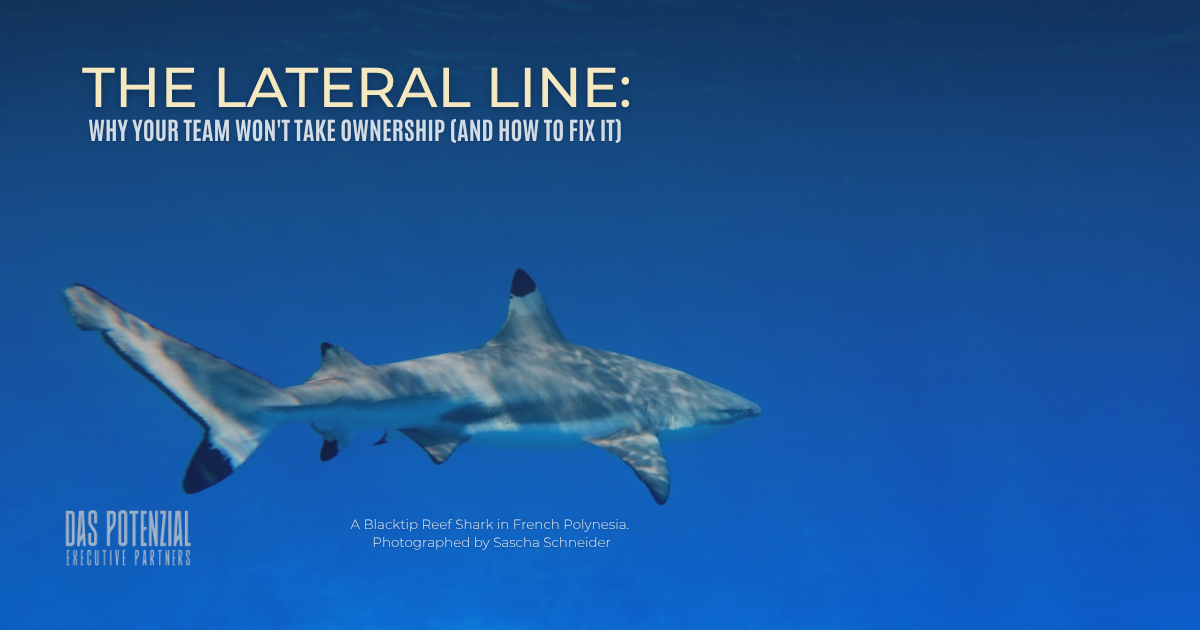
When most people look at a Blacktip Reef Shark, they look at the teeth. I look at the lateral line.
Sharks have a sensory organ running down their side that detects microscopic shifts in water pressure. They literally feel the environment moving before they see it.
And as a scaling founder, your business intuition is your lateral line. You feel market shifts before the data even prints.
It is the unconscious muscle memory that allowed you to survive the chaotic reef of early-stage growth. But it is also the exact reason you are awake at 2:00 AM, exhausted, Googling variations of the same frustrated question. You want to know why your brilliant minds will not take ownership.
The hard truth is that your team isn’t lacking talent or alignment. They are failing because they do not have your lateral line. They cannot feel the unwritten rules of the business that live exclusively in your head.
The Trap of the Overfunctioning Leader
When your team misses the mark, your default reaction is to step in. You fix the pitch deck. You smooth over the client crisis. You jump in to save the day.
You absorb the anxiety of the entire system by taking on excess responsibility. It gives you the illusion that things are moving fast, but the long-term impact is catastrophic.
By constantly playing the hero, you accidentally train your team to wait for your direction. You breed a toxic culture of learned helplessness. You expect a self-sustaining operation, but you have trapped yourself as the mechanic, constantly fixing gears that refuse to turn on their own.
Execution Dies in the Silos
Execution usually dies in horizontal coordination.
When your marketing, product, and sales teams do not know how to collaborate across their silos, they escalate every single conflict up to you. Instead of driving growth, you spend your days as a highly-paid referee in inter-departmental turf wars.
You do not need to work harder. You are an apex operator. You need constructive friction to translate your unconscious logic into a structural framework your team can actually execute against.
How to Stress-Test Strategy and Scale Your Intuition
We build this alignment through a three-step mechanical extraction:
- Extract the Context: Stop answering edge cases. Identify the top unwritten rules you unconsciously use to make daily decisions.
- Filter for Appropriateness: Define the strict boundaries of your organization’s core identity. Your team needs to know exactly what an automatic ‘No’ looks like without having to ask you.
- Apply Selective Involvement: Unbounded founder mode easily turns into toxic micromanagement. You must establish a selective involvement framework to reserve your lateral line for mission-critical vectors while aggressively delegating the rest.
Q&A: Navigating Organizational Friction
Why won’t my team take ownership? Teams fail to take ownership when the unwritten rules of the business remain locked in the founder’s head. Without an explicit framework for decision-making, employees default to waiting for leadership direction to avoid making mistakes.
How do I stop micromanaging my team? You must build an environment with high psychological safety where people can admit mistakes, but where peers rigorously hold each other to the standard. Stop burning out trying to do everyone’s job.
I work as an Executive Sparring Partner. I sit shoulder-to-shoulder with leaders to map these exact blind spots so they can extract their unwritten rules and reclaim their capacity. Grab the map, and let’s get to work.